“Just the prejudice…of the leaders”

Impact: How can it repeatedly be said “the prophet will never lead us astray” when apparently the first 10 did exactly that if the doctrine on “blacks and the priesthood” turned out to not be doctrine but just the prejudice and opinions of the leaders? How does that not count as leading the church astray? If they can do it on something that effects an entire race of people what else could they do it on?

Name: Danny

Date: 16 JUL 2014

Impact Topic: Race and the Priesthood

“If they would just own up to being wrong…”

Impact:  It is upsetting learning about these things because, yes, it feels as though I have been lied to. It is also extremely insulting to think the leadership was trying to “protect us” from the truth because they seemed to believe we couldn’t handle the facts. The history doesn’t bother me nearly as much as this “we know what’s best for you to know” attitude that feels so pervasive now. It now seems much of what I was told was anti-mormon propaganda wasn’t a pack of lies as I was told growing up, but rather it was more a pack of inconvenient truths.


For me, if they would just own up to being wrong where they were wrong (E. G. Blacks and the priesthood) it would lend a whole lot more credibility to the organization than these we-weren’t-wrong-really-you-just-don’t-understand explanations they like to throw out there. It’s like they want to show us they are trying to make progress, but only just enough so that we’ll see it, acknowledge it, tell them to keep up the good work, and then they can go back to the status quo because, after all, they did make an effort. 


I guess what I’m trying to say here is that if my kids had been telling fits or not the whole truth the same way the church has, I would sit down and talk to them about why it is important to be honest and then ground them from electronics and video games for a week so they’d learn that actions have consequences. If they persisted in insisting that hadn’t done anything wrong, then it would be 2 weeks, because that is unacceptable behavior and if it continues unchecked and my kids think that’s how you are supposed to operate in the world then they would be on track to become the next Mark Shurtleff. I don’t want that to happen. That guy is the worst.

Name: Spence

Date: 16 Jul 2014

Impact Topic: Cover up and Excommunications

“Historians… want to tell the truth.”

Impact:  I am a born in the covenant, life long member, in fact my family on both sides goes all the way back to Kirtland Ohio. My father was a seminary and institute teacher and Stake Patriarch. I was the youngest of five kids, and the obedient one, who didn’t like confrontation. So I did all the things you were suppose to do. Graduated from seminary, served a mission, graduated from Institute (even thought of becoming a seminary teacher at one time, like the idea of having summers off), married a good Mormon girl in the temple, had four children, baptized them all, and worked my way up to a High Priest. My whole life revolved around the church. As the Internet became more pervasive, I started venturing looking at so-called “anti-Mormon” information or what others might call “LDS History Porn.” This research started to raise a lot of questions and raise old questions from the past that that I had just been placed on the proverbial “shelf.” The “light bulb” finally turn on for me when I read about a quote by Boyd K. Packer, where in essence he says the problem with historians is they want to tell the truth, regardless whether it is uplifting or not. When I read that quote the whole “shelf” completely collapsed. All of this stuff I had been shelving for years came gushing forth, it all made sense. The church has been lying to me and everyone else, about its history, because if they told the true history it would not be uplifting; therefore it is okay to lie. It was then I realized that the LDS church itself would not qualify for it’s own temple recommend, because it would fail the questions “Are you honest in your dealings with your fellow men?” Although we all know the Church will still get a temple recommend because they would just tell another lie so they could get their recommend.

Name: Keith

Date: 15 Jul 2014

Impact Topic: Cover up and Excommunications

“I was able to… be re-born”

Impact:  I hadn’t even been looking at so called ‘anti-mormon’ stuff before my ‘awakening’, but simply wanted answers to temple symbolism and the meaning of the endowment. God showed me those answers, but from there on out, it became a faith transition. I would say I have moved thru Mormonism, or maybe even beyond it in some degrees, where the church was a starting point for my life and existence, but after being ‘awakened’ (as the endowment teaches) I was able to crush my ego (as in the temple) and be re-born, spiritually, a new celestial creature. Now the historical issues are just that; historical and not part of my life. They don’t affect my future, but they helped me progress. And as long as Mormonism is progressing, although it is very slow, then we have hope. We lose patience though and it is very difficult to navigate when the waters remain muddy for so long.

Name: Jared

Date:  15 Jul 2014

Impact Topic: Temple

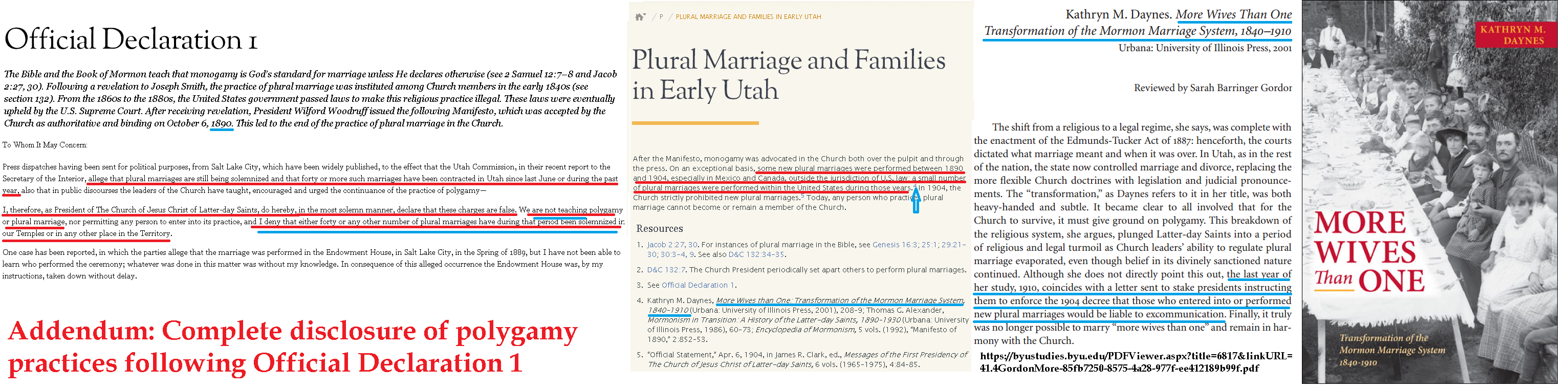
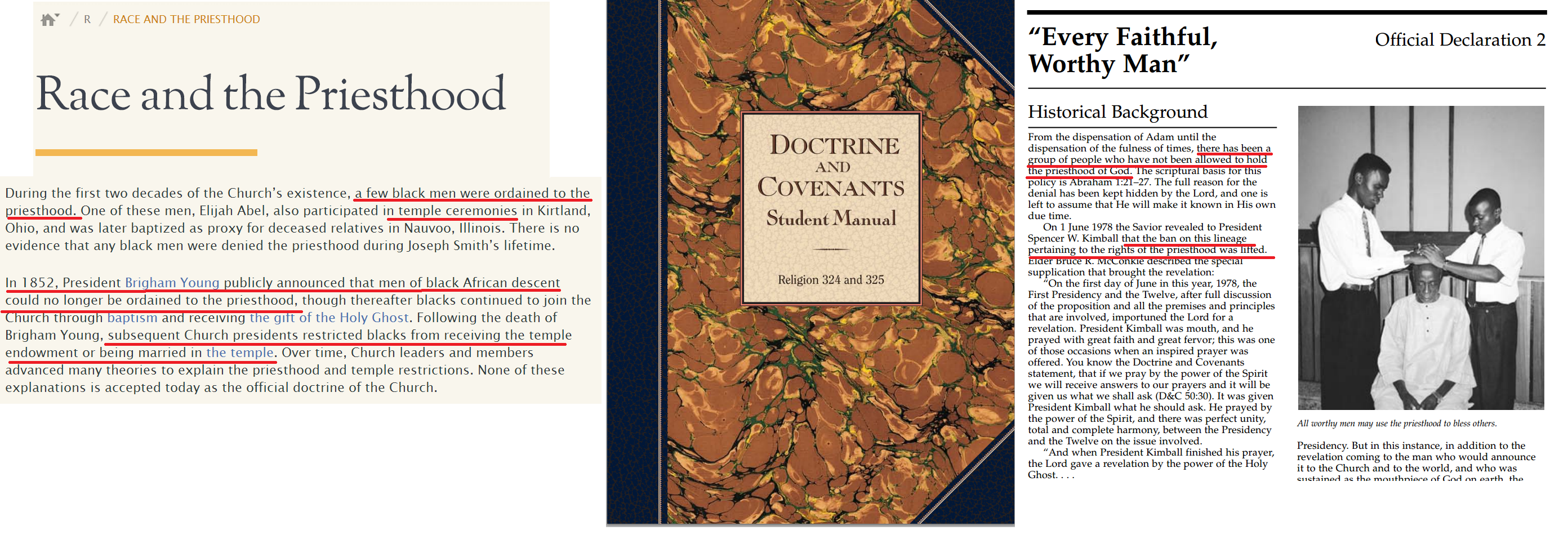
Addendum #12- Doctrine and Covenants Student Manual, Official Declaration 2

black and priesthood 1.1

https://www.lds.org/bc/content/shared/content/english/pdf/language-materials/32493_eng.pdf?lang=eng

“The lengths I saw some go…”

Impact: I am a BYU graduate, temple married, 20- something who has served as Relief Society president and Young Women adviser among other callings. My husband is a very traditional believer and my crisis of faith put our marriage in a tough spot for awhile. I feel extremely fortunate that our marriage is holding strong because I know this is not always the case when a spouse looses belief in the church.  Church historical issues was a lot to take in, but I may have been able to reconcile if I didn’t feel lied to and manipulated by the church. The fact that I couldn’t even have an informed conversation with those who were supposed to be a source of spiritual support (i.e. Bishop, RS pres, etc.) was the tipping point. As well, the lengths I saw some go to rationalize or dismiss just about anything did me in. (i.e. Joseph smith had wives who had living husbands. No he didn’t! Confirm information. It dosnt matter! End of discussion.)

Name: Anonymous

Date: 15 Jul 2014

Impact Topic: Polygamy

“I became more disaffected”

Impact: My catalyst was the Book of Abraham. A trusted friend told me it wasn’t true which started me doing a lot if research, as the historical falsehoods piled up I became more disaffected. My husband’s started with his disdain for the practices of shaming that the church employs.

Name:  Anonymous

Date: 15 Jul 2014

Impact Topic: Book of Abraham

“The rest came tumbling down”

Impact: Throughout my life there have been doctrines that I disagreed with but was told to shelve and have faith that it would all work out in the end. After so many years of frustration I realized none of those doctrines mattered if I didn’t have a testimony of Joseph Smith. When I realized the amount of deception, lies, and cover-ups on his part the rest came tumbling down. The pain comes from the realization of how much my belief in the church informed every decision I made. I hope I am able to recover from the amount of damage it has caused to my psyche.

Name: Anonymous

Date: 15 Jul 2014

Impact Topic:  General

“I… never heard… the real historical accounts”

Impact:  I was born in the covenant, grew up active, attended 4 years of early morning seminary, served a full 2 year mission, graduated from BYU (with almost 40 credits in religion) and never heard any of the real historical accounts, just white washed history. The church teaches to be honest in everything you do- this seriously clashed with me when I found they had been telling the “truth” from their own perspective.

Name: Anonymous

Date:  15 Jul 2014

Impact Topic: General

“It was intolerable”

Impact: The historical issues proved the Church wasn’t true, but I might not have left just because it was not true (I no longer believed any church was true). I left because it was intolerable. I could not stand all of the Joseph Smith praise, the homophobia, the unequal treatment of women, the emphasis on obedience, the brainwashing of children with songs like “Follow the Prophet”, the discouragement of any real treatment of the difficult issues at church, the suspicion of unworthiness if one doesn’t enthusiastically take callings, etc.

Name: David

Date: 15 Jul 2014

Impact Topic: General

“I would lose my entire world”

Impact: I learned while dating in my single years, that if the person you are dating doesn’t want you to talk to opposing sources, it is because they have something to hide. So after years of humming and hawing over it, I decided to take a peek, and found out its the same thing on a grander scale here. The hardest part for me isn’t what they did to me as far as lying or the history(which sucks, don’t get me wrong) but the fact that if I were to openly come out about it, I would lose my entire world as I know it and my daughter would be indoctrinated against me by ‘well meaning’ individuals. As myself, I will never be good enough or worthy because of the indoctrination of everyone on my life. THAT is what sucks to me.

Name: Elizabeth

Date: 15 Jul 2014

Impact Topic: General

“I felt so stupid”

Impact:  I remember sitting in BYU religion classes in tears, literally falling in love with an absurdly romantic version of church history. I felt so stupid when I started learning even a balanced view. Like finding out at age 30 that there really was no Santa.

Name: Jon

Date: 15 Jul 2014

Impact Topic: General

“There are serious… trust issues”

Impact: There are too many issues to ignore. It’s not like there’s just one problem, or two, or five. Once you start studying the historical issues, it’s a deep rabbit hole. Almost everything that makes Mormonism unique has serious factual problems. Also related, almost every historical/factual problem has serious “spin” or trust issues from the church related to it. I think the historical/factual issues would have been enough [to weaken faith], but the feelings of betrayal of trust can’t be ignored, either. Even if apologetic “answers” can satisfy someone, (for me they don’t,) the lies and betrayal are also enough to make one seriously question if the church is what it presents itself to be.

Name: Anonymous

Date: 15 Jul 2014

Impact Topic:  General

“I could get multiple conflicting answers”

Impact:  Trying to make sense of the historical problems forced me to reevaluate how I determined truth. If truth was based on feelings and emotions I could get multiple conflicting answers. So I had to look elsewhere to define truth. But once I abandoned how I felt about it there was nothing else supporting LDS truth claims.

Name: Michael

Date: 15 Jul 2014

Impact Topic: General

“My good name, nature, obedience, and faith… has been abused”

Impact: Someone told me the Book of Abraham was a fraud. I called them a liar and went to LDS.org to dispel the information they gave me about it.

I felt the blood drain out of me when, after a search, I found confirmation of what the ‘anti’ mormon had said was truth.

Literally, my entire life changed right there. I couldn’t sleep. I couldn’t eat. I felt sick. I couldn’t work. I delved deeply into church historical records to try and get rid of my sudden ‘doubt’ about what has been taught to me. I had fill that sudden, explosion in the dam that was my faith in Joseph Smith as a prophet and as an honest man.

The next thing I discovered was that South Park teaches more truths about Joseph Smith than the church. And then I discovered Joseph’s wifes. My testimony in Joseph died right there, along with my belief that the LDS church is led by honest men.

I continued learning. The rabbit hole is deep and the church is a cesspit.

My childhood, my life has been stolen by deceitful men – from the past and and present. I have been used. My good name, my good nature, and my obedience and faith in God has been abused.

Now I’m a middle-aged woman, with no identity. I’m completely broken. The LDS church has stolen my childhood and youth. They have ruined my life, and ruined my trust in God. They have taken the very best of it and given nothing but lies and deceit back.

I hope, those men who have denied me my agency, and who would have me deny my children’s agency by continuing perpetuating myths, are held accountable one day soon.

Impact Topic: The Book of Abraham

Name: Jen

Date:  14 Jul 2014

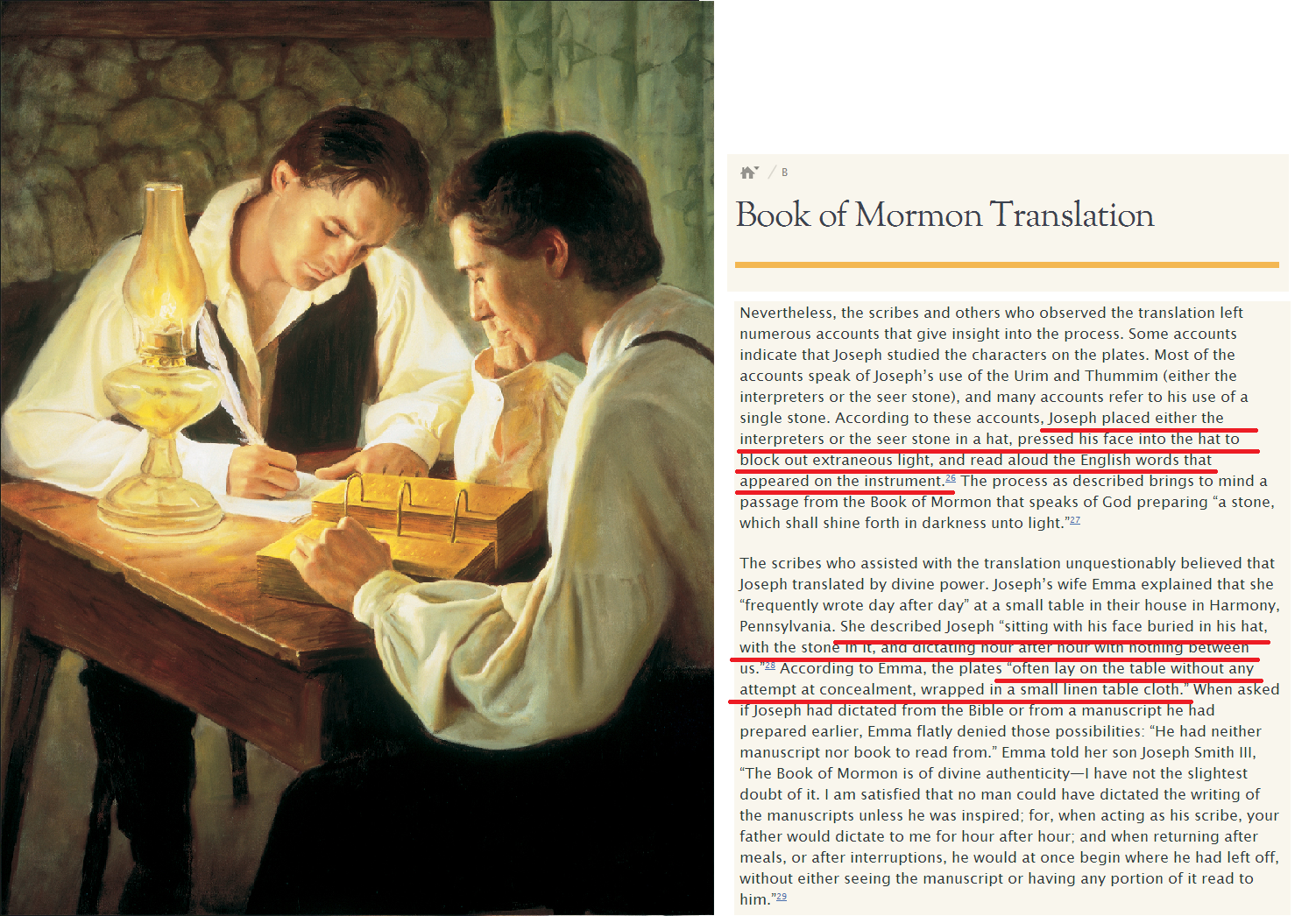
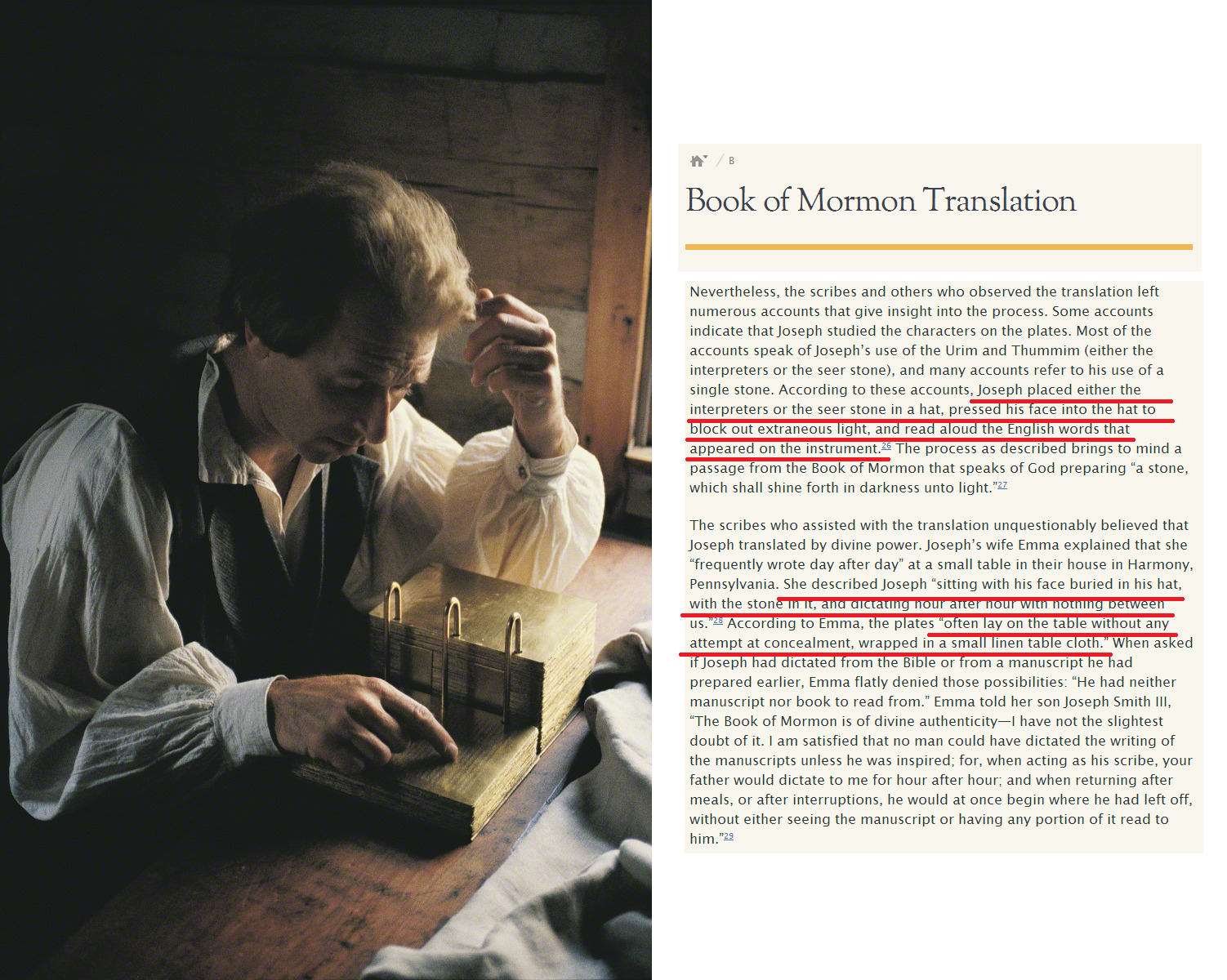
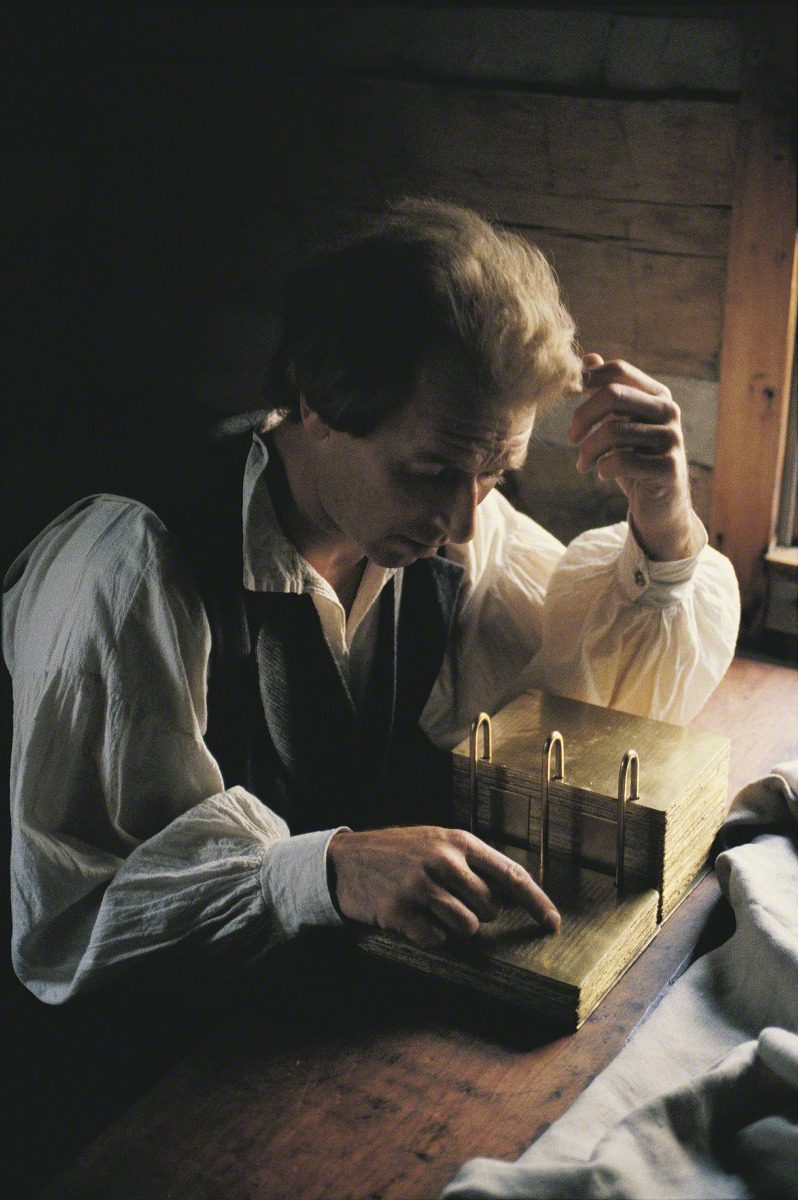
Addendum #10- Artwork: Joseph Translating the Book of Mormon, Number 2

Book of Mormon Translation 1.2

(http://media.ldscdn.org/images/media-library/gospel-art/church-history/translating-plates-82841-wallpaper.jpg)


“I felt betrayed”

Impact:  I felt betrayed. After learning this stuff, I lost all trust in our leaders and everything they’ve said. If they lied about this, what else have they / will they lie about?  And since the devil is “the father of lies,” what does that say about our church?

Impact Topic: Book of Mormon Translation

Name: Heather

Date: 11 July 2014

From “Monumental” to “Quaint”

Impact Topic: Book of Mormon Translation

Name: Kevin

Date: 11 July 2014

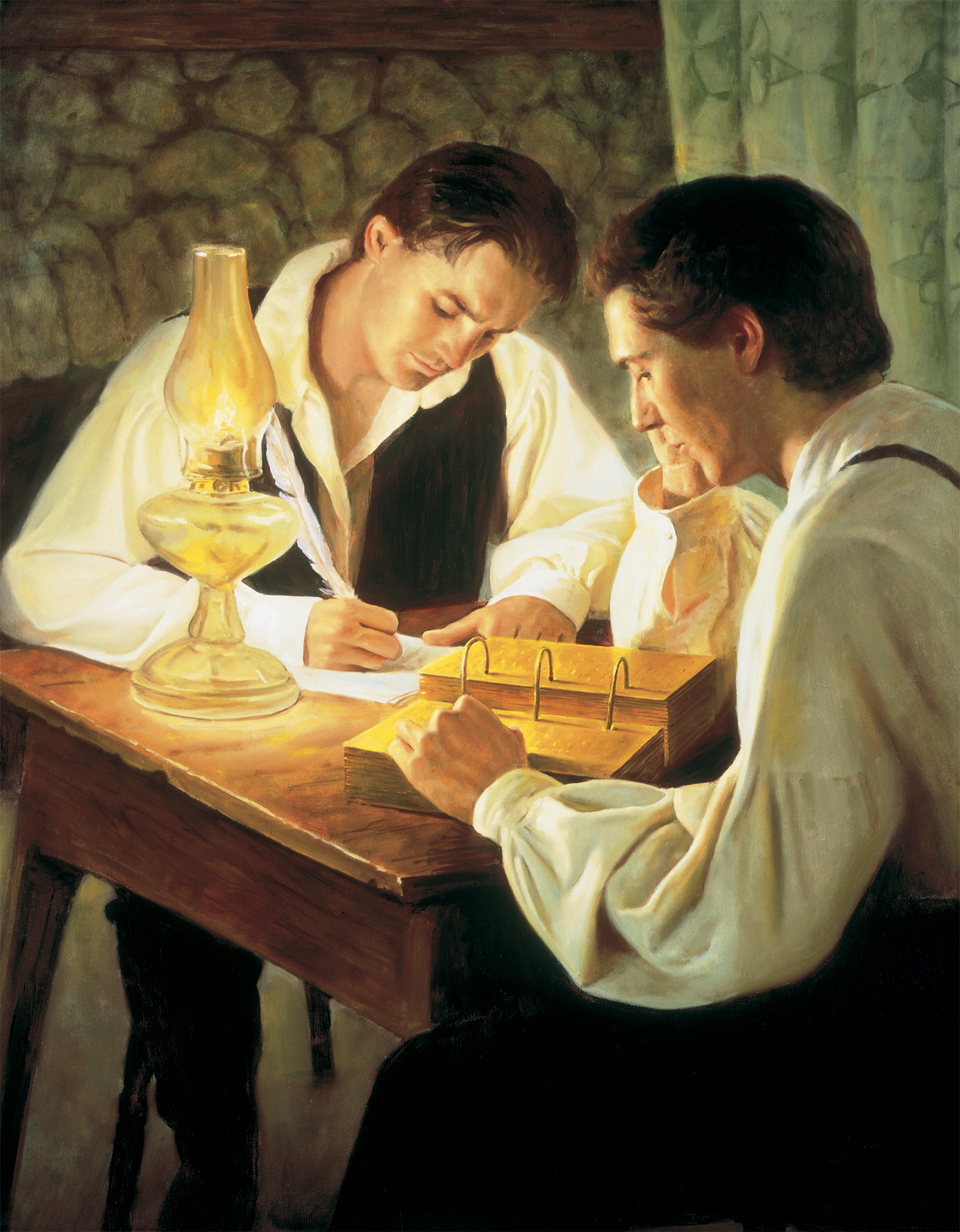
Impact:  When I was younger the image reinforced Joseph’s diligence in what must have been a monumental task. When I learned about Joseph apparently using a seer stone in his hat to facilitate an experience of receiving the BoM by revelation the illustration became quaint and rather dull to me. I much prefer the notion of revealed meaning of an ancient text.

“Age 27 without ever knowing”

Impact Topic: Book of Mormon Translation

First Name: Jarel

Date: 11 Jul 2014

Impact: This issue for me was less that Joseph used the stone in the hat method to translate, it was hurtful because I could be raised and educated in the church and make it to age 27 without ever knowing that. It made me realize that the modern day leaders were okay with lying to members and investigators in order to paint a more believable picture. The hypocrisy of this coming from an organization that requires members to be “honest in all their dealings with their fellow men” makes me feel betrayed and angry.

“My whole life…”

Impact Topic:  Book of Mormon Translation

First Name: Daniel

Date: 11 JUL 2014

Impact:  It is telling that in this article, “Urim and Thumim” now include the seer stone.  My whole life Urim and Thumim were the spectacles attached to a breast plate, not a seer stone.  The new definition is “either the interpreters or the seer stone.”

Addendum #9- Artwork: Joseph Translating the Book of Mormon, Number 1

Book of Mormon Translation 1.1http://media.ldscdn.org/images/media-library/gospel-art/church-history/joseph-translating-gold-plates-329346-print.jpg

“A More Mature View of What Happened in That Grove…”

Impact Topic:  First Vision Accounts

First Name: Clay

Date:  10 JUL 2014

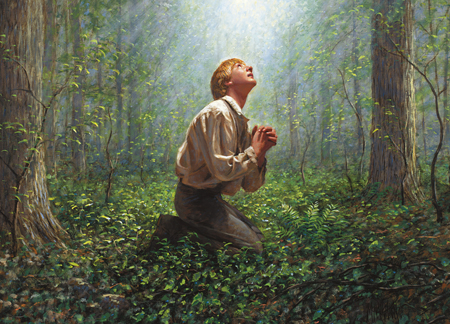
Impact:  I only first learned about the multiple accounts of the first vision in a Church History class in college before my mission, but thought little of the discrepancies.  Later when I put the discrepancies into context after married and deep in my educational endeavors, I realized that the potent emphasis that we place on the First Vision story is a relatively new phenomenon and that early church members may not have even known about the First Vision at all.  It was troubling to hear that the story was told differently numerous times.  I wondered and still wonder why the multiple accounts are never something we talk more about.  All those times that I related the first vision over and over on my mission, I never dreamed that I was actually just presenting what the vision might have been.  I would have appreciated being viewed as capable of digesting the real history so that I could interpret the facts myself.   I can see how Joseph might have had trouble recalling the vision the same way over the years, or maybe all of them are just a fraction of what actually happened.  Knowing the truth has helped me to have a more mature view about what happened in that grove of trees.  That understanding can now no longer be shaken by learning facts of which I was previously kept ignorant.  The entire process has increased my empathy for others and reaffirmed my conviction and belief in a God that isn’t affected by the errors that humans make.

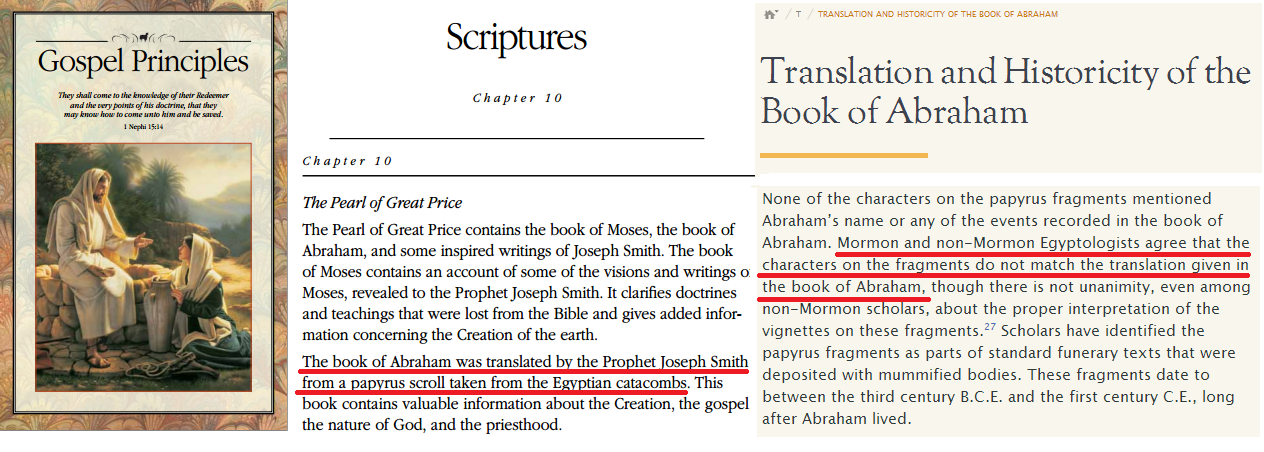
Addendum #8- Gospel Topics Essay, Translation and Historicity of the Book of Abraham

https://www.lds.org/topics/translation-and-historicity-of-the-book-of-abraham

Book of Abraham Chaper 1.1

Addendum #5- Gospel Principles, Chapter 17: The Church of Jesus Christ Today

The Church of Jesus Christ Was Taken from the Earth

  • Why was the Church of Jesus Christ removed from the earth shortly after the Savior’s death and Resurrection?

When Jesus lived on the earth, He established His Church, the only true Church. He organized His Church so the truths of the gospel could be taught to all people and the ordinances of the gospel could be administered correctly with authority. Through this organization, Christ could bring the blessings of salvation to mankind.

After the Savior ascended into heaven, men changed the ordinances and doctrines that He and His Apostles had established. Because of apostasy, there was no direct revelation from God. The true Church was no longer on the earth. Men organized different churches that claimed to be true but taught conflicting doctrines. There was much confusion and contention over religion. The Lord had foreseen these conditions of apostasy, saying there would be “a famine in the land, not a famine of bread, nor a thirst for water, but of hearing the words of the Lord. … They shall … seek the word of the Lord, and shall not find it” (Amos 8:11–12).

The Lord Promised to Restore His True Church

  • What were some of the conditions in the world that prepared the way for the Restoration of the gospel?

The Savior promised to restore His Church in the latter days. He said, “I will proceed to do a marvellous work among this people, even a marvellous work and a wonder” (Isaiah 29:14).

For many years people lived in spiritual darkness. About 1,700 years after Christ, people were becoming more and more interested in knowing the truth about God and religion. Some of them could see that the gospel Jesus taught was no longer on the earth. Some recognized that there was no revelation and no true authority and that the Church that Christ organized did not exist on the earth. The time had arrived for the Church of Jesus Christ to be restored to the earth.

  • In what ways is the Restoration of the fullness of the gospel a “marvelous work”?

New Revelation from God

  • When Joseph Smith received his First Vision, what did he learn about God?

In the spring of 1820, one of the most important events in the history of the world occurred. The time had come for the marvelous work and wonder of which the Lord had spoken. As a young boy, Joseph Smith wanted to know which of all the churches was the true Church of Jesus Christ. He went into the woods near his home and prayed humbly and intently to his Heavenly Father, asking which church he should join. On that morning a miraculous thing happened, as recorded in four separate accounts written (at the earliest) 12 years after the event. [1]  In one of these accounts, Heavenly Father and Jesus Christ appeared to Joseph Smith.  In that account, the The Savior told him not to join any church because the true Church was not on the earth.  He also said that the creeds of present churches were “an abomination in his sight” (Joseph Smith—History 1:19; see also verses 7–18, 20). Beginning with this event, there was again direct revelation from the heavens. The Lord had chosen a new prophet. Since that time the heavens have not been closed. Revelation continues to this day through each of His chosen prophets and members are invited to seek personal revelation to confirm in their own hearts what they hear from church leaders. [2]  Joseph was to be the one to help restore the true gospel of Jesus Christ.

  • Why was the First Vision one of the most important events in the history of the world?

Authority from God Was Restored

  • Why was the restoration of the Aaronic and Melchizedek Priesthoods necessary?

In restoring the gospel, God again gave the priesthood to men. John the Baptist came in 1829 to confer the Aaronic Priesthood on Joseph Smith and Oliver Cowdery (see D&C 1327:8), as Joseph first taught 3 years later in 1832 and first included in revisions of church documents 6 years later in 1835. [3, 4] Then Peter, James, and John, the presidency of the Church in ancient times, came and gave Joseph and Oliver the Melchizedek Priesthood and the keys of the kingdom of God (see D&C 27:12–13), although the actual date was never known. [3] Later, additional keys of the priesthood were restored by heavenly messengers such as Moses, Elias, and Elijah (see D&C 110:11–16). Through the Restoration, the priesthood was returned to the earth. Those who hold this priesthood today have the authority to perform ordinances such as baptism. They also have the authority to direct the Lord’s kingdom on earth.

For teachers: Bearing testimony invites the Spirit. As part of this lesson, bear your testimony of the Restoration and give others the opportunity to do the same.

Christ’s Church Was Organized Again

  • What events led to the organization of the Church on the earth again?

On April 6, 1830, the Savior again directed the organizing of His Church on the earth (see D&C 20:1). His Church is called The Church of Jesus Christ of Latter-day Saints (see D&C 115:4), but was actually first named “The Church of Christ” in 1830, then was changed to “The Church of the Latter-Day Saints” in 1834, and then ultimately changed to its current name in 1838. [5] Christ is the head of His Church today, just as He was in ancient times. The Lord has said that it is “the only true and living church upon the face of the whole earth, with which I, the Lord, am well pleased” (D&C 1:30).

Joseph Smith was sustained as prophet and “first elder” of the Church (see D&C 20:2–4). Later the First Presidency was organized, and he was sustained as President. When the Church was first organized, only the framework was set up, although the ambiguity surrounding appropriate leadership after the death of Joseph Smith led to numerous factions splintering and forming separate churches. [6, 7]  That members of the church that followed Brigham Young grew into the  The organization that continued to would develop as the Church continued to grow. [7]

Addendum: There were multiple at least 4 accounts of the first vision, of which the 1838 version is most commonly cited, with significant differences and discrepancies between the accounts.  The name of the church went through multiple revisions and renamings, each of which in a context of controversy and disagreement among members of the church at each timepoint.  The Priesthood restoration documentation occurred retrospectively after many years, which emphasizes that immediately after 1829, the majority of members were not aware of its occurrence.  At the time of succession, the church splintered into multiple factions based on doctrinal differences, which has now grown into multiple smaller organizations that fall within the umbrella of the LDS movement, namely the Community of Christ (formerly known as the Reorganized Church of Jesus Christ of Latter-day Saints), and others.

1. https://www.lds.org/topics/first-vision-accounts?lang=eng&query=first+vision

2. https://www.lds.org/general-conference/2010/10/obedience-to-the-prophets?lang=eng

3. https://www.lds.org/ensign/1996/12/the-restoration-of-the-aaronic-and-melchizedek-priesthoods?lang=eng

4. https://www.lds.org/ensign/2013/01/great-and-marvelous-are-the-revelations-of-god?lang=eng

5. https://www.lds.org/ensign/1996/12/the-restoration-of-the-aaronic-and-melchizedek-priesthoods?lang=eng

6. https://www.lds.org/general-conference/1981/04/the-joseph-smith-iii-document-and-the-keys-of-the-kingdom?lang=eng&query=reorganized

7. https://www.lds.org/ensign/1979/09/nineteenth-century-break-offs?lang=eng&query=jospeh+smith+III

Addendum #4- Gospel Topic Essays, Translation and Historicity of the Book of Abraham

https://www.lds.org/topics/translation-and-historicity-of-the-book-of-abraham?lang=eng#30

The Papyri

After the Latter-day Saints left Nauvoo, the Egyptian artifacts remained behind. Joseph Smith’s family sold the papyri and the mummies in 1856. The papyri were divided up and sold to various parties; historians believe that most were destroyed in the Great Chicago Fire of 1871. Ten papyrus fragments once in Joseph Smith’s possession ended up in the Metropolitan Museum of Art in New York City.24 In 1967, the museum transferred these fragments to the Church, which subsequently published them in the Church’s magazine, the Improvement Era.25

The discovery of the papyrus fragments renewed debate about Joseph Smith’s translation. The fragments included one vignette, or illustration, that appears in the book of Abraham as facsimile 1. Long before the fragments were published by the Church, some Egyptologists had said that Joseph Smith’s explanations of the various elements of these facsimiles did not match their own interpretations of these drawings. Joseph Smith had published the facsimiles as freestanding drawings, cut off from the hieroglyphs or hieratic characters that originally surrounded the vignettes. The discovery of the fragments meant that readers could now see the hieroglyphs and characters immediately surrounding the vignette that became facsimile 1.26

None of the characters on the papyrus fragments mentioned Abraham’s name or any of the events recorded in the book of Abraham. Mormon and non-Mormon Egyptologists agree that the characters on the fragments do not match the translation given in the book of Abraham, though there is not unanimity, even among non-Mormon scholars, about the proper interpretation of the vignettes on these fragments.27 Scholars have identified the papyrus fragments as parts of standard funerary texts that were deposited with mummified bodies. These fragments date to between the third century B.C.E. and the first century C.E., long after Abraham lived.

Of course, the fragments do not have to be as old as Abraham for the book of Abraham and its illustrations to be authentic. Ancient records are often transmitted as copies or as copies of copies. The record of Abraham could have been edited or redacted by later writers much as the Book of Mormon prophet-historians Mormon and Moroni revised the writings of earlier peoples.28 Moreover, documents initially composed for one context can be repackaged for another context or purpose.29 Illustrations once connected with Abraham could have either drifted or been dislodged from their original context and reinterpreted hundreds of years later in terms of burial practices in a later period of Egyptian history. The opposite could also be true: illustrations with no clear connection to Abraham anciently could, by revelation, shed light on the life and teachings of this prophetic figure.

Some have assumed that the hieroglyphs adjacent to and surrounding facsimile 1 must be a source for the text of the book of Abraham. But this claim rests on the assumption that a vignette and its adjacent text must be associated in meaning.  The text of the Book of Abraham (chapter 1, verses 7-17 [1]) directly references facsimile 1, assisting the reader to understand the depiction of the priest of Elkenah and the various idolatrous gods.  Additionally, Joseph translated the facsimiles themselves and these were also confirmed to be an incorrect translation. [2]   In fact, it was not uncommon for ancient Egyptian vignettes to be placed some distance from their associated commentary.30

Addendum:  There is no factual way to refute that Joseph’s translation was incorrect, as confirmed by all notable Egyptologists.   Arguments that the text is unrelated to the papyri are false because the text directly references the facsimiles and the facsimiles themselves were incorrectly translated.

Meaning: From a secular perspective, the explanations provided from the church and its apologists are actual attempts at deception because they argue that adjacency of the text to the figures to which it alludes can be called into question, however, this does not negate the fact that the facsimiles are, in and of themselves, an incorrect translation, and that they are directly referenced in the text of the Book of Abraham.  From a faithful perspective, belief in the doctrines expounded in the the Book of Abraham is a personal choice and cannot be refuted historically.  Believing that the book could have been received similarly to how other revelations were received does not violate historical evidence.

References

1- https://www.lds.org/scriptures/pgp/abr/1?lang=eng

2-https://www.lds.org/topics/translation-and-historicity-of-the-book-of-abraham?lang=eng#30

Addendum #3- The Pearl of Great Price Student Manual, The Book of Abraham.

https://www.lds.org/manual/the-pearl-of-great-price-student-manual/the-book-of-abraham?lang=eng

Who Is Abraham and When Did He Live?

Adam and Eve and the Fall (approximately 4000  B.C.), Enoch (approximately 3000  B.C.), Noah and the Flood (approximately 2400  B.C.), and the tower of Babel (approximately 2200  B.C.) preceded Abraham’s time. Abraham, who was born in about 2000  B.C., was the father of Isaac and the grandfather of Jacob, whose name was changed toIsrael. (See Bible Dictionary,“chronology,” 635–36.)

How Did the Church Obtain the Book of Abraham?

On 3 July 1835 a man named Michael Chandler brought four Egyptian mummies and several papyrus scrolls of ancient Egyptian writings to Kirtland, Ohio. The mummies and papyri had been discovered in Egypt several years earlier by Antonio Lebolo. Kirtland was one of many stops in the eastern United States for Chandler’s mummy exhibition. Chandler was offering the mummies and rolls of papyrus for sale and, at the urging of the Prophet Joseph Smith, several members of the Church donated money to purchase them. In a statement dated 5 July 1835, Joseph Smith, declaring the importance of these ancient Egyptian writings, recorded: “I commenced the translation of some of the characters or hieroglyphics, and much to our joy found that one of the rolls contained the writings of Abraham. … Truly we can say, the Lord is beginning to reveal the abundance of peace and truth” (History of the Church, 2:236).  Use of the word “Translation” here does not denote the typical definition of changing a text from one language to another by expert knowledge.  Mormon and non-Mormon Egyptologists agree that the characters on the fragments do not match the translation given in the book of Abraham [1].

How Did the Prophet Translate the Ancient Writings?

The Prophet Joseph Smith never communicated his method of translating these records. As with all other scriptures, a testimony of the truthfulness of these writings is primarily a matter of faith. The greatest evidence of the truthfulness of the book of Abraham is not found in an analysis of physical evidence nor historical background, but in prayerful consideration of its content and power.

Why Did the Prophet Joseph Smith Say He Translated the Writings of Abraham When the Manuscripts Do Not Date to Abraham’s Time?

In 1966 eleven fragments of papyri once possessed by the Prophet Joseph Smith were discovered in the Metropolitan Museum of Art in New York City. They were given to the Church and have been analyzed by scholars who date them between about 100  B.C.and A.D.  100. A common objection to the authenticity of the book of Abraham is that the manuscripts are not old enough to have been written by Abraham, who lived almost two thousand years before Christ. Joseph Smith never claimed that the papyri were autographic (written by Abraham himself), nor that they dated from the time of Abraham. It is common to refer to an author’s works as “his” writings, whether he penned them himself, dictated them to others, or others copied his writings later.

What Did the Prophet Joseph Smith Do with His Translation?

The book of Abraham was originally published a few excerpts at a time inTimes and Seasons, a Church publication, beginning in March 1842 at Nauvoo, Illinois (see Introductory Note at the beginning of the Pearl of Great Price). The Prophet Joseph Smith indicated that he would publish more of the book of Abraham later, but he was martyred before he was able to do so. Concerning the potential length of the completed translation, Oliver Cowdery once said that “volumes” would be necessary to contain it (see Messenger and Advocate, Dec. 1835, 236).

In addition to hieroglyphic writings, the manuscript also contained Egyptian drawings. On 23 February 1842, the Prophet Joseph Smith asked Reuben Hedlock, a professional wood engraver and member of the Church, to prepare woodcuts of three of those drawings so they could be printed. Hedlock finished the engravings in one week, and Joseph Smith published the copies (facsimiles) along with the book of Abraham. Joseph Smith’s explanations of the drawings accompany the facsimiles.

What Happened to the Mummies and the Papyri?

After the death of the Prophet Joseph Smith, the four mummies and the papyri became the property of Joseph’s widowed mother, Lucy Mack Smith. At Lucy’s death in 1856, Emma Smith, the Prophet’s wife, sold the collection to Mr. A. Combs. Several theories have been offered regarding what happened subsequently to the mummies and the papyri. It appears that at least two of the mummies were burned in the great Chicago fire of 1871 (see B. H. Roberts, New Witnesses for God, 3 vols. [1909–11], 2:380–382).

In the early spring of 1966, Dr. Aziz S. Atiya, a University of Utah professor, discovered several fragments of the book of Abraham papyri while doing research at the Metropolitan Museum of Art in New York City. These fragments were presented to the Church by the director of the museum on 27 November 1967. The current whereabouts of the other mummies and the other portions of the papyri are unknown (see H. Donl Peterson, “Some Joseph Smith Papyri Rediscovered (1967)” inStudies in Scripture, Volume Two, 183–85).

What Is the Significance of the Book of Abraham?

The book of Abraham is an evidence of the inspired calling of the Prophet Joseph Smith. It came forth at a time when the study of the ancient Egyptian language and culture was just beginning. The scholars of the 1800s had scarcely begun to explore the field of Egyptology, and yet, with no formal training in ancient languages and no knowledge of ancient Egypt (except his work with the Book of Mormon), Joseph Smith began his translation of the ancient manuscripts, although translation is globally agreed to not correctly describe the record and it is now thought to have been received by some other form of revelation and not linguistic translation [1].  His knowledge and ability came through the power and gift of God, together with his own determination and faith.

The book of Abraham reveals truths of the gospel of Jesus Christ that were previously unknown to Church members of Joseph Smith’s day. It also casts a bright light upon difficult passages found in other scriptural texts.

Addendum:  The Book of Abraham cannot be considered a translation of ancient papyri.  Egyptologists agree that the published text in the Pearl of Great Price does not correctly correspond to the hieroglyphics nor the facsimiles, which are therein referenced.

Meaning: From a secular perspective, the Book of Abraham represents one of the most potent weaknesses arguing against the divine origins of Mormonism, given that a canonized document purported to be translated and widely understood as such for generations of church instruction, has now definitively been proven be incorrect.  From a faithful perspective, the significance of the Book of Abraham and the doctrines therein can still be accepted and believed as a divinely-received revelation, despite it not being a historcially-valid document.

Personal Impact:  pending

References:

1. https://www.lds.org/topics/translation-and-historicity-of-the-book-of-abraham


Addendum #2- Doctrine and Covenants and Church History, Chapter 35, A Mission of Saving

https://www.lds.org/manual/doctrine-and-covenants-and-church-history-gospel-doctrine-teachers-manual/lesson-35-a-mission-of-saving?lang=eng&query=willie+handcart

1. President Brigham Young guided the rescue of the Martin and Willie handcart companies.

Display the picture of the Martin handcart company. Summarize the first paragraph under “Handcart Pioneers” on page 77 of Our Heritage. Then share the following account as told by President Gordon B. Hinckley:

“I take you back to the general conference of October 1856. On Saturday of that conference, Franklin D. Richards and a handful of associates arrived in the valley. They had traveled from Winter Quarters with strong teams and light wagons and had been able to make good time. Brother Richards immediately sought out President Young. He reported that there were hundreds of men, women, and children scattered over the long trail. … They were in desperate trouble. Winter had come early.  After admonishment from their church leaders that God would protect their party, hundreds chose to depart Nebraska in late summer, despite their knowledge of late departure and guaranteed  unprotected travel through harsh mountain winter.  Their leaders, “Prophesied in the name of God that we should get through in safety. Were we not God’s people, and would he not protect us? Even the elements he would arrange for our good.”   Snow-laden winds were howling across the highlands. … Our people were hungry; their carts and their wagons were breaking down; their oxen dying. The people themselves were dying. All of them would perish unless they were rescued.

“I think President Young did not sleep that night. I think visions of those destitute, freezing, dying people paraded through his mind. The next morning he came to the old Tabernacle which stood on this square. He said to the people:

“‘I will now give this people the subject and the text for the Elders who may speak. … It is this. … Many of our brethren and sisters are on the plains with handcarts, and probably many are now seven hundred miles from this place, and they must be brought here, we must send assistance to them. The text will be, “to get them here. …

“‘That is my religion; that is the dictation of the Holy Ghost that I possess. It is to save the people. …

“‘I shall call upon the Bishops this day. I shall not wait until tomorrow, nor until the next day, for 60 good mule teams and 12 or 15 wagons. I do not want to send oxen. I want good horses and mules. They are in this Territory, and we must have them. Also 12 tons of flour and 40 good teamsters, besides those that drive the teams. …

“‘I will tell you all that your faith, religion, and profession of religion, will never save one soul of you in the Celestial Kingdom of our God, unless you carry out just such principles as I am now teaching you. Go and bring in those people now on the plains’ (in LeRoy R. Hafen and Ann W. Hafen,Handcarts to Zion [1960], 120–21).

“That afternoon, food, bedding, and clothing in great quantities were assembled by the women. The next morning, horses were shod and wagons were repaired and loaded. The following morning, … 16 mule teams pulled out and headed eastward. By the end of October there were 250 teams on the road to give relief” (in Conference Report, Oct. 1996, 117–18; or Ensign, Nov. 1996, 85–86).

Point out that the Martin and Willie handcart companies had done all they could to reach the Salt Lake Valley, but they could go no farther. They needed to be rescued. Without the rescue parties, they all would have died.

Addendum:  It is important to emphasize the faith of the members of the Willie handcart companies.  Numerous party members warned of the impending winter conditions and admonished the saints to stay in Nebraska for another season.  Church leaders admonished party members to proceed onward, promising that they would be protected and safe from the elements [1].  Opposing voices were reprimanded and silenced to minimize their influence.

Meaning:  From a secular perspective,  knowing that church leaders advocated for a late summer departure and knowingly promoted the application of faith to oppose rationale fear of death and summering is extremely concerning.  While is does not refute the appropriateness of rescuing the handcart company, it does call into question the appropriateness of priesthood leader influence and to what degree rationale thought should be supplanted by faith.  From a faithful perspective, the death and morbidity of the handcart companies may be viewed as a necessary sacrifice resulting in a faith-promoting experience inspiring generations.

References: 

1. http://handcart.byu.edu/ (Journal Entry August 13, 1856)

2. http://handcart.byu.edu/Sources/LeviSavage.aspx

Addendum #1- Teachings of Joseph Fielding Smith, Chapter 1, Our Father in Heaven

https://www.lds.org/manual/teachings-of-presidents-of-the-church-joseph-fielding-smith/chapter-1-our-father-in-heaven?lang=eng“

Beginning with Joseph Smith’s First Vision, the true knowledge of God has been restored in our day.

I am very grateful for the 1838 account of the first vision, in which the Father and the Son appeared to the youthful prophet and again restored to man the true knowledge of God.3

Through Joseph Smith’s First Vision, “the true knowledge of God” was restored.

It should be remembered that the entire Christian world in 1820 had lost the true doctrine concerning God. The simple truth which was understood so clearly by the apostles and saints of old had been lost in the mysteries of an apostate world. All the ancient prophets, and the apostles of Jesus Christ had a clear understanding that the Father and the Son were separate personages, as our scriptures so clearly teach. Through apostasy this knowledge was lost. … God had become a mystery, and both Father and Son were considered to be one unknowable effusion of spirit, without body, parts, or passions. The coming of the Father and the Son placed on the earth a divine witness who was able by knowledge to restore to the world the true nature of God.4

The 1838 account of the [first] vision of Joseph Smith made it clear that the Father and the Son are separate personages, having bodies as tangible as the body of man. It was further revealed to him that the Holy Ghost is a personage of Spirit, distinct and separate from the personalities of the Father and the Son [seeD&C 130:22]. This all-important truth staggered the world; yet, when we consider the clear expressions of holy writ, it is a most astounding and wonderful fact that man could have gone so far astray. The Savior said, “My Father is greater than I;” [John 14:28] and he invited his disciples, after his resurrection, to handle him and see that it was he, for, said he, “A spirit hath not flesh and bones, as ye see me have.” [Luke 24:39.] The apostles clearly understood the distinct entities of the Father, Son, and Holy Ghost, to which they constantly refer in their epistles; and Paul informed the Corinthians of the fact that when all things are subjected to the Father, “then shall the Son also himself be subject unto him that put all things under him, that God may be all in all.” [1 Corinthians 15:28.]

In the 1838 account of the first vision, Joseph Smith beheld the Father and the Son; therefore he could testify with personal knowledge that the scriptures were true wherein we read: “So God created man in his own image, in the image of God created he him; male and female created he them.” [Genesis 1:27.] This was to be understood literally, and not in some mystical or figurative sense.5

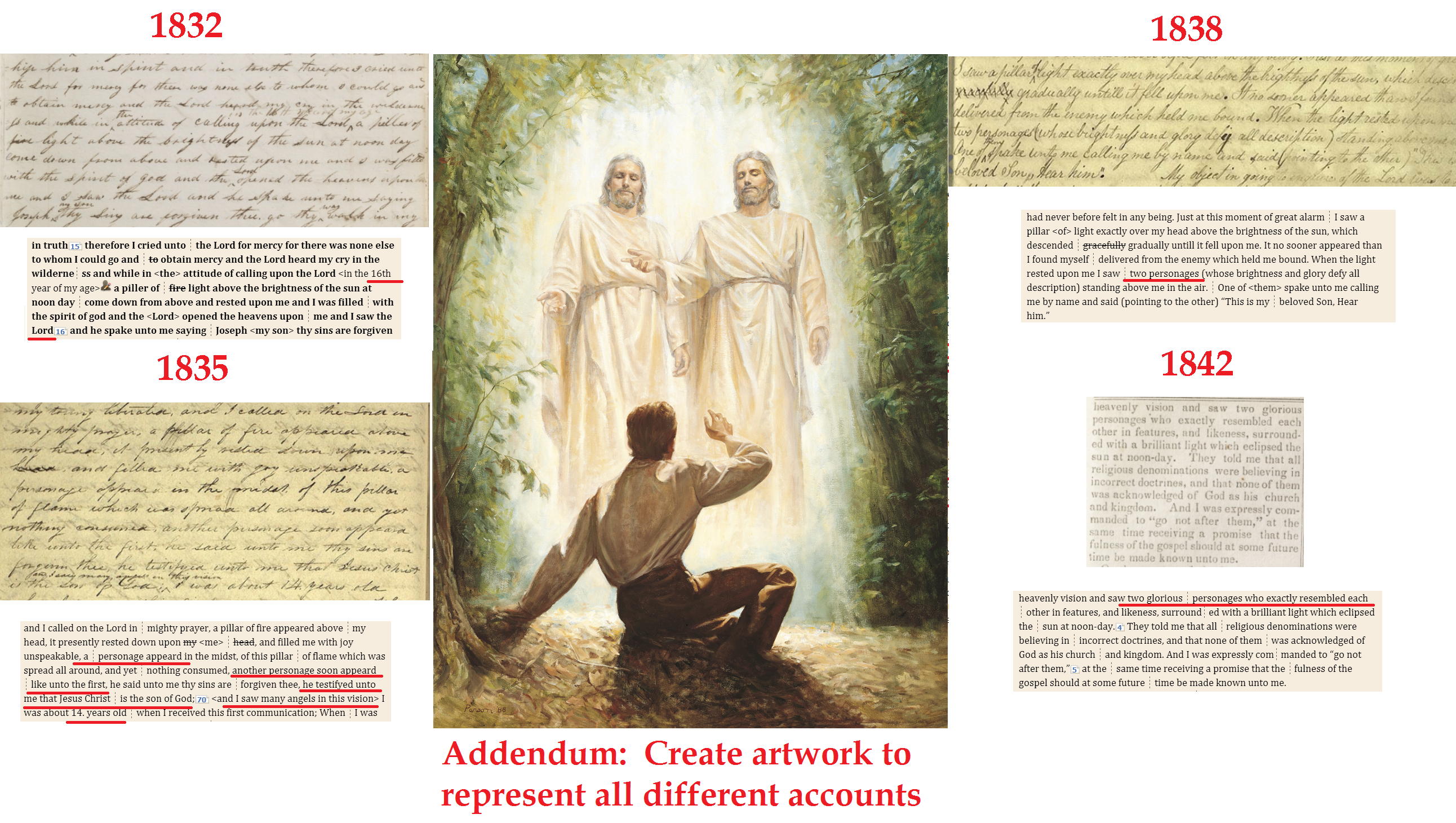
Addendum:  There are several (at least 4) different recorded accounts of the first vision given by Joseph Smith, which contain some contradictory information.  Although the first vision occurred in 1820, the first recitation of the vision was not documented until 12 years later in 1832 [1], and subsequent version were recorded in 1835 [2], 1838 (most common) [3], and 1842[4].  The personages appearing to Joseph in these encounters are different and the significance of this is debated.  In 1832, Joseph reported that two unidentified personages appeared sequential (and not simultaneously) to him, that the second verbally referenced Jesus Christ, and that he thereafter saw many angels during the vision.  In 1835, Joseph recorded that “the Lord” appeared to him without mention of the Father.  The 1838 account is the one most commonly known and taught, and the 1842 account records the appearance of two personages of exact likeness.
Meaning:  From a secular perspective the discrepancies of accounts as well the prolonged time between when the vision occurred and when the vision was reported are problematic and suggest that the vision may have been changed over time and that is certainly less important (and perhaps unknown) in the early church than it currently taught.  From a faithful perspective, the discrepancies may be explained by the difficulty of retelling a story so many years later.  While acknowledging that historical discrepancies exist, the later emphasis of subsequent church leaders on the 1838 rendition highlights attention on the significance the Church wants members to place on God the Father and Jesus Christ as two separate personages.
References:

1-The Joseph Smith Papers. http://josephsmithpapers.org/paperSummary/history-circa-summer-1832?p=1.  Accessed 7/3/14.

2-The Joseph Smith Papers. http://josephsmithpapers.org/paperSummary/journal-1835-1836?p=24. Accessed 7/3/14.

3-The Joseph Smith Papers. http://josephsmithpapers.org/paperSummary/history-circa-june-1839-circa-1841-draft-2?p=2. Accessed 7/3/14.

4-The Joseph Smith Papers. http://josephsmithpapers.org/paperSummary/church-history-1-march-1842?p=1. Accessed 7/3/14.